It has been a long time. I took a break from writing to put my artistic vision into perspective. Also, a day-job, running a dance school and organising performances, learning Te Reo, exploring my artistic pursuit and trying to read and research.. I was practically drowning in responsibilities and commitments!
Bangarra – photo sourced from Google
During this time, I also got a chance to go to Sydney for my close friend’s wedding. A break that I much needed. This city of immigrants was bustling with people always in a hurry. It is a world totally different from where I am partly from – my small town Dunedin. While in Sydney, dancing and enjoying a fabulous wedding, meeting old friends and making new, I also made time to do all touristy things. My highlight was going to the Sydney Opera House and watching Bangarra Dance Theatre celebrating 30 years of existence in Australia out of 65,000!
Mohiniyattam – a graceful dance form that I would like to explore more – physically and as a keen researcher. This dance form is practiced by artists around the world gaining popularity as years go by. As I am in the process of unlearning and relearning my art forms, I decided to start from where it all began.
A dance form from Kerala, it is said that Mohiniyattam is mentioned in Vyavaharamala of the early 18th century and in the Malayalam novel Meenakshi. Other common references for Mohiniyattam students have for years been works of Sri. P. Soman, Guru Kalyanikuttyamma, Dr. Kanak Rele, and Smt. Leela Nambudiripad. And not to forget the contributions made by Gurus Kunjukutty amma and Chinnammu amma, and their association with the Kerala Kalamandalam.
But who did Guru Kunjukutty Amma learn from? Was she a performer? Who did Guru Kalyanikutty Amma learn from? How was Mohiniyattam before its revival at Kerala Kalamandalam? Who danced this dance form? Has it always been performed by women? Kerala as a state was formed in 1950, so has Mohiniyattam always been a part of this region? Of course, I have heard how Mohiniyattam was saved from the ‘ill reputed’ women who used to practice it. But where did they learn from? Who are their Gurus? There were a lot of missing links about the origin of the dance form. Continue reading “Writing Mohiniyattam’s History – Justine’s Journey”→
Have you been following Minai’s www.cinemanrityagharana.blogspot.com? Oh! What a treasure trove it is for us cinema enthusiasts, dancers, or anyone who appreciates Cinema and dance! The blog focuses on Indian dance forms in Indian cinema. I myself have looked up to that blog to find how our dance sequences in Indian movies have changed over the years. I have always wanted to know more about the writer behind this blog because trust me, that is a lot of research going into spotting the dancer on-screen, identifying the dance form and who the choreographer is. Minai’s blog makes all this easy for you. Finally, I tracked down Cassidy Minai, the author of the blog and we spoke about her life, interests and her favourite Indian dancers on-screen. Continue reading “Passionate about Indian Cinema and Dance”→
“I am attracted to poetics of Kathak – the ghazals, qawwalis and thumris. I have been trying to combine both – the technicalities and the emotiveness and by doing so how to reconstruct the emotiveness in a way that it becomes a part of the socio-political context,” says Pallabi Chakravorty , author, academician, anthropologist and an accomplished Kathak exponent based in USA. This three way model of bringing arts into her life can be also be seen in her book, Bells of Change: Kathak Dance, Women and Modernity in India. In this book, she retraces the origins of Kathak back to bhaijis and tawaifs of Kolkata and follows their path from a woman’s perspective.
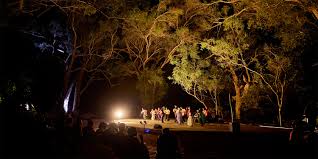
As part of Perth Festival, the BhuMeJha project is not simply a performance, it is an immersive ceremonial experience. Set against the fading light of the Perth Hills, the work invites audiences into a shared space of ritual, storytelling, movement, and cultural exchange. It moves beyond the conventions of traditional theatre, dissolving the boundary between performer and participant and guiding audiences through a multi-sensory journey grounded in land, lineage, and living tradition.
Presented at The Art Sanctuary in Kelmscott by Saraswathi Mahavidyalaya and Chitambara, the evening begins with a smoking ceremony – a gentle yet powerful invitation to pause, breathe, and arrive fully. The scent of sacred herbs drifts through the air. Guests wander the tranquil grounds. They explore spaces like Saraswati Ghat, Shiva Ghat, and the goshaala. Their experience is enriched by live music and homemade refreshments. The atmosphere encourages unhurried presence and quiet connection.
As dusk settles, the ceremonial performance unfolds. Artists bridging Noongar, Indian, Malaysian, and Yolŋu heritage weave chant, rhythm, and storytelling into an evocative expression of shared land and ancestry. At the heart of the soundscape is Wagilak Yolŋu Songman Daniel Wilfred, whose powerful vocals resonate through the amphitheatre. Music designer and performer Hariraam Tingyuan Lam works with Malaysian artist Mohammad Hisharudy. Together, they layer Indian and Malaysian musical traditions into a sonic landscape. This landscape feels both expansive and intimate.
Under the mentorship of Sukhi Shetty Krishnan, Creative Director at Saraswati Mahavidyalaya, dancers move in a fluid, boundary-crossing vocabulary drawing from contemporary practice, Garba, Bharatanatyam, folk, Kathak, Odissi, Kandyan, and contact improvisation. A First Nations dancer (I wish I knew her name and couldn’t find her name in the credits as well.) mirrors and responds to these forms, exploring the profound and unifying theme of Mother, Ma Ganga, creating a compelling cross-cultural dialogue through gesture and breath. The choreography resists categorisation; instead, it unfolds deliberately, allowing each movement and note space to resonate.
The natural environment amplifies the experience. Surrounded by towering trees beneath a canopy of stars, the audience sits informally on picnic blankets, hay bales, and low chairs, choosing their own vantage point. As night deepens, voices echo across the hills, dissolving the distance between stage and spectator.
In the closing moments, the invitation to join becomes literal. Guided by Daniel Wilfred, the audience joins in First Nations dance steps, transforming observation into embodied experience. The final communal rhythm encapsulates the project’s ethos: this is not spectacle, but shared ceremony.
Behind the seamless integration of ritual, music, and movement is Creative Producer Kamal Thurairajah, whose vision ensures that the evening unfolds as a cohesive and deeply felt journey.
What distinguishes The BhuMeJha Project is its commitment to long-term collaboration and genuine cultural exchange. This is not fusion for novelty’s sake, but a work shaped by years of trust-building and dialogue across communities. The evening moves through stages of arrival, immersion, performance, and celebration, culminating in shared food, music, and reflection under the night sky.
At its heart, The BhuMeJha Project is an invitation: to breathe more deeply, to listen more carefully, to feel the land beneath your feet, and to recognise the connections that emerge between different lineages bound by shared stories of river, earth, and belonging.
Through Kathak, Sufi music, and exquisite staging, Songs of the Bulbul channels grief, devotion, and ecstasy. This performance lingers long after the final note. The nightingale’s cry becomes both myth and meditation on the artist’s life.
Hello everyone! I’m back to writing after a long hiatus. I moved countries, and the busy life of motherhood pushed my writing to the backseat. Last night, I returned not just to writing, but to experiencing art in its most visceral form. I attended the opening night of Songs of the Bulbul, performed by Aakash Odedra at the Perth Festival. As we entered His Majesty’s Theatre, the strains of Ganj‑e‑Shakar, a devotional Sufi song in praise of Hazrat Baba Farid, played as house music. Its gentle, reverent hum instantly drew us into the world of the performance, setting the stage for the Sufi myth at its heart.
In Sufi literature, the bulbul, the nightingale, is never just a bird. In the words of Rumi, Hafiz, and Attar, it becomes the human soul, restless and incandescent with longing. Opposite it blooms the rose, radiant, unattainable, a symbol of the Divine.
The bulbul sings, in ache and ecstasy, devotion fierce enough to pierce and consume. Its song trembles between rapture and grief. It yearns to transcend the self and return to what was never truly separate.
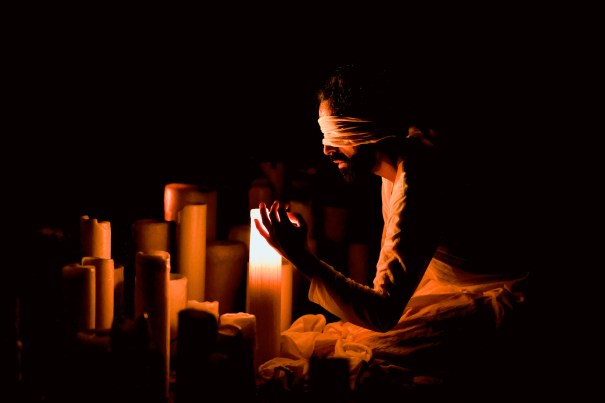
In Odedra’s performance, the nightingale’s eyes are gouged out, it cries, a sound suspended between grief and devotion. The myth transforms into a meditation on the artist’s life: giving everything in each act of creation, leaving pieces behind. Creation becomes both loss and offering, a language that carries beyond the body, the moment, and the eyes that no longer see.
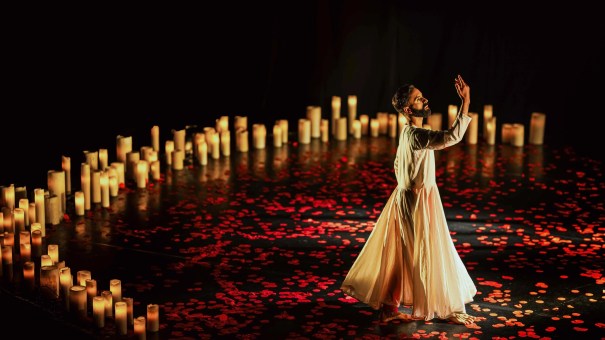
The dance begins at the edge of becoming. Odedra’s body curls, searching, holding itself in quiet tension. Slowly, he unfurls, tasting the vastness of the sky. Freedom emerges in subtle gestures, shifts of weight, turns, leaps, and precise Kathak footwork. Flight gives way to constraint as space tightens, echoing the passage of time and the narrowing of life. His spiraling body evokes the whirling dervishes, filling the expansive stage.
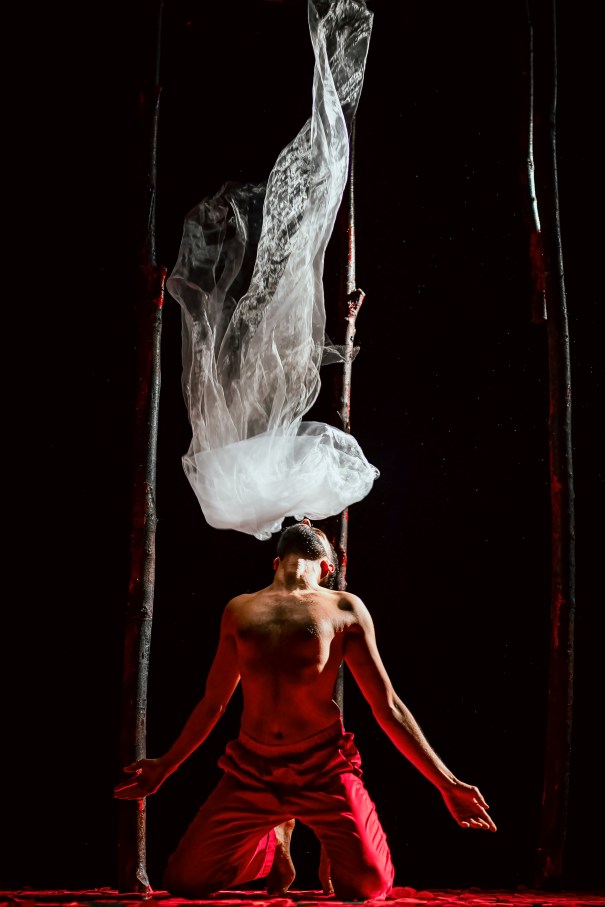
Rose petals drift and swirl as he glides, leaps, and spins, tracing the bulbul’s longing. In the final moments, candles flicker and gauze drifts onto the stage. Odedra lifts and sweeps the fabric, flowing with the light. Through the interplay of gauze, glow, and petals, the soul seems to rise; weightless, luminous, meeting the Divine.
Odedra is a striking dancer, his movements imbued with rare fluidity. His dance seamlessly blends the precision of Kathak with contemporary expression, creating a language of motion that is both technically breathtaking and profoundly emotive. The choreography, crafted by the acclaimed Rani Khanam, a master of the Lucknow gharana style of Kathak, draws deeply from Islamic and Sufi texts. She weaves tradition and imagination into every gesture, layering each movement with devotion, philosophy, and subtle beauty.
Music by Rushil Ranjan lifts the performance to another level. Sound and silence exist in equal measure, reverberating in the body long after notes fade. The qawwali Allahu Allahu Allahu pulses like a heartbeat, a call to presence beyond fear and noise. In a tense, fractured world, its repetition offers solace, insistence, and devotion.
Lighting designer Fabiana Piccioli bathes the stage in shifting shadows and gentle glows, sculpting space and mood so that every movement, rose petal, and flicker of gauze feels suspended in a luminous, almost otherworldly atmosphere.
Catch Songs of the Bulbul at the Perth Festival from February 13–15, 2026, and let yourself be carried into another world.
Songs of The Bulbul
Perth Festival Review: Odedra’s Songs of the Bulbul
Yashoda Thakore has fought against all odds to uphold the tradition of the Kalāvantulu community* and their dance repertoire. And what drove her with passion all these years? It is the realisation that she belongs to this artistic community. She is one among them. Let me take you through her journey of self-realisation and her commendable work that she has been doing so far and plan to do more in the future.
It was just three years ago that I chanced upon a book called Sweating Saris: Indian Dance as Transnational Labor written by Dr Priya Srinivasan. This book was an eye opener for me. It made me really question – What is modern? What is traditional? How are we so interconnected? I couldn’t believe that the wave of modern dance started by Ruth St Denis was inspired by the devadasis. Why is this connection never spoken about? Talking to the author herself, I realised I am not the only one going through this wave of emotions, of unlearning and re-learning and re-imagining history.
Dr Priya Srinivasan accompanied by Carnatic singer Uthra Vijay in the show ‘Nagarathnammal’s Dream’ premiered at the Mumurthigal Festival on May 20, 2017 organised by Smt Narmatha and Sri Ravi M Ravichandhira (OAM). Photo Supplied
 NatyaLoka