
Mudh: A Moving Exploration of Home, Belonging and Sisterhood

There is something incredibly raw, honest and beautiful about community performances. What makes Mudh so moving is not just the technical perfection or synchronisation, but the humanity of it all. Presented by STRUT Dance, Mudh premiered on November 13th &14th at Bina Parkland at Balga. On Saturday, I watched twenty-six women of different ages, ethnicities, backgrounds and abilities, some trained in dance and others stepping onto a performance stage for the very first time, come together to share something deeply personal.

At its heart, Mudh explores home, identity, belonging and connection. Through stories drawn from the countries these women come from, their Indigenous identities, homelands and lived experiences, the performance opens conversations about rejection, displacement, trauma and the search for a place to call home. Yet it is also a story of hope, resilience and the extraordinary strength that emerges when women come together.
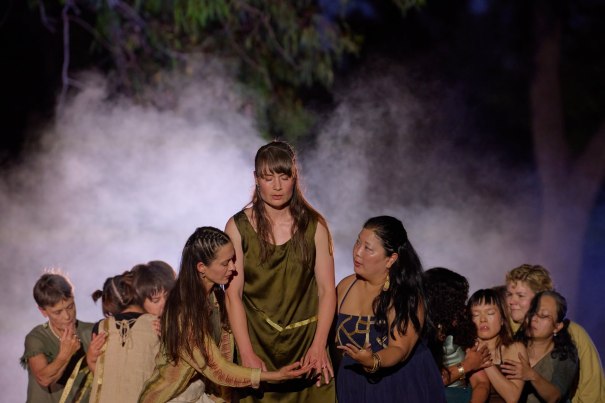
Mudh presented by STRUT Dance choreographed by Sonya Stephen.
Photo Credit: STRUT Dance

The title Mudh, meaning home in the Mabuyag dialect of Kala Lagaw Ya, the traditional language of the Western and Central Torres Strait Islands, provides an important cultural foundation for the work. For choreographer and lead creative Sonya Stephen, the exploration of home is deeply personal, shaped by her Torres Strait Islander heritage, family, ancestry and connection to place. What began as an exploration of migrant women’s experiences in the City of Stirling evolved into something broader, encompassing the many ways we understand identity and belonging. It reminds us that home is not simply where we come from, but also the culture, memories, relationships and stories we carry with us.
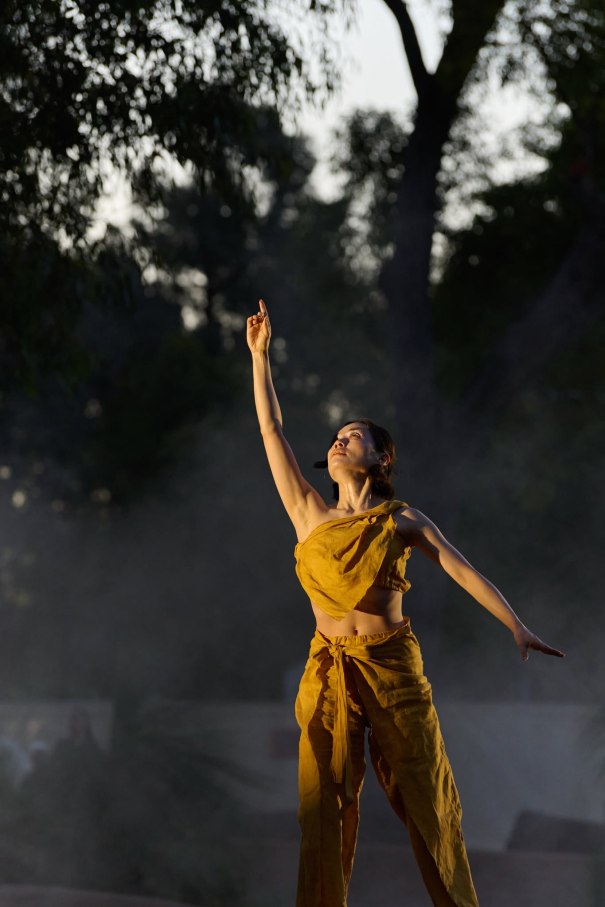
Mudh performed at Bina Parkland on Nov 13 & 14. Photo credit: STRUT Dance

What struck me most was the sense of collective care. The way women hold one another, wrap themselves around each other and offer love, understanding and acceptance. There is a powerful message in that togetherness. Individual stories find a collective voice, differences are embraced, and something beautiful emerges from the act of moving together. The presence of the Goddess, always somewhere in the background, seemed to reinforce this sense of feminine strength, nurturing and solidarity.

Under Sonya’s wonderful guidance, months of workshops, conversations and shared experiences have brought these women together. You could feel the trust, vulnerability and courage that had developed along the way. Importantly, these women were not simply performing stories about diversity and belonging; they were sharing fragments of their own lives and experiences. For women whose voices are often underrepresented or unheard, having the opportunity to tell their stories in their own way is enormously powerful. For some, simply taking up space and performing in front of an audience was an achievement in itself. The strength of this performance lay in its authenticity.

The choice of site added another layer to the experience. Set at Bina Parkland, beneath the shelter of the big trees, the performance felt connected to the land and the community around it. Balga, with its rich cultural diversity and intersecting stories of migration, identity and belonging, was a fitting place for this work. The setting became more than a backdrop; it felt like an extension of the stories being told.

The music by Andy O’Neil deepened the emotional texture of the performance and drew the audience into the women’s journeys. There were moments of tenderness, strength and confrontation. You could sense the audience absorbing the stories and perhaps recognising fragments of their own experiences within them.

Perhaps that is the most powerful thing about Mudh. It reminds us that home is not necessarily a fixed place. It can be a country, a landscape, a memory, a culture or the people who make us feel safe and accepted. Sometimes home is something we leave behind; sometimes it is something we are still trying to find. And sometimes, we create it together.

Watching these twenty-six women move as a collective left me thinking not only about identity and belonging, but also about the future. Will government policies, particularly those affecting migrant, Indigenous and culturally diverse communities, reflect this understanding of home, connection and genuine inclusion? Will there be room for all these stories, histories and identities to belong?

Mudh was more than a dance performance. It was a beautiful, heartfelt and deeply human experience. This is a performance that deserves to be seen by everyone.
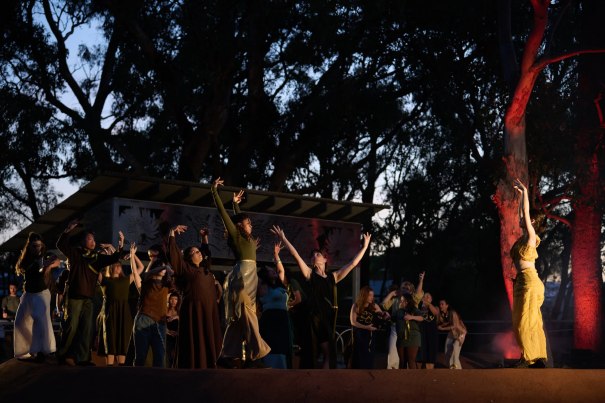
Mudh presented by STRUT Dance at Bina Parkland, Balga. Photo: STRUT Dance

Choreographer & Lead Creative: Sonya Stephen

Lead producer: Janine Oxenham

Assistant Producer & Choreographer: Isha Sharvani

Sound Design and Music: Andy O’Neill

Production Manager & Lighting Designer: Peter Young

Performers:

Core Team
Aki Sato-Johnson
Catherine Antulov
Claudia Alessi
Hemamalini Vijay

Isha Sharvani
MJ Anderson-Hyde
Stella Mara
Toni Moran

Community Participants
Aggie Caracciolo
Ankita Ghunawat
Annette Wiguna
Beatrice Stotzer
Caroline Edwards
Clare O’Sullivan
Clarice Yuen
Ellen Kang
Georgia Eleni Douvartzidis
Hannah Lucas
Jordan Galliott
Kandy Fabreo Montelongo
Kathleen Szalay
Maija Raittinen
Melissa Fabreo Montelongo
Sahaja Springer
Sophia Bowden
Young Eun Choi

Shobana’s Australia dance tour

When Applause Precedes Performance: Celebrity, Nostalgia and the Changing Audience for Indian traditional Dance

The standing ovation started before I could decide whether I believed it. I was still sitting. Something about the applause felt familiar…automatic. And I found myself asking: were we applauding the dance, or the actor we already knew?

That question stayed with me throughout Bhav, staged in Perth on 15 May 2026 at the Churchlands Senior High School Auditorium. The sold-out performance, presented by renowned artist Shobana and her dance ensemble, drew an audience eager to experience one of India’s most celebrated dancers and actors.

The evening began with something worth acknowledging. At around 6:50 pm, Shobana herself announced that the audience should be seated by 6:55 pm and that the programme would begin at 7:00 pm. And it did…on time, precise, intentional.

But the audience told a different story. People kept entering even after the performance had begun, some as late as 7:45 pm. Each entrance fractured attention, not dramatically, but enough to remind you that live performance depends on shared silence.

Then came the phones. Despite repeated requests, recording continued. At one point, she stopped mid-performance and firmly asked people to put their phones away, making it clear that if filming continued, she would stop dancing. Some found it strict. I didn’t. Because something gets lost when a performance becomes content. Bharatanatyam doesn’t survive distraction easily; it needs attention the way breath needs space.

Bhav explored the history of Bharatanatyam (though inaccurately), vrittis, navarasa, koothu, folk elements, film songs, and more. It was a mix of many themes. At one point, visuals of the Ram Mandir in Ayodhya appeared on screen, an image that today carries strong political resonance in India.

But something else was already in the room long before the first step of dance: memory.

Shobana is not just a dancer; she is also a popular South Indian actress. Beyond her own performances, her legacy is also evident in the work of her students, who continue to reflect and extend her stylistic influence in Bharatanatyam in the ensemble performances. At one point, she danced to her own film songs. When she appeared as Nagavalli from Manichitrathazhu, the audience cheered enthusiastically.

Cultural memory doesn’t behave politely. It overlaps. It interferes. It edits what we see in real time. Research on autobiographical memory suggests that nostalgia doesn’t just recall the past, it softens present judgment while amplifying emotional attachment. So, we don’t just watch a performance; we revisit a feeling.

As a Bharatanatyam practitioner, I think a lot about abhinaya, not just expression, but presence. The kind that is built internally before it is shown externally. Watching, I kept drifting back to her older recordings: the precision, the intensity, the stillness between movements.

But memory is a dangerous reference point. It doesn’t update itself. It idealises. Psychologists describe this as temporal comparison bias – we unconsciously measure the present against a heightened version of the past.

If the exact same performance had been given by an unknown dancer, would the response have been the same? Would there have been a standing ovation or would we have quietly critiqued what we now generously overlook?

Part of the answer lies in what psychology calls the halo effect. If we admire someone in one domain, we tend to extend that admiration into others. Celebrity intensifies this even further. We don’t arrive as neutral observers; we arrive already invested. Research on audience perception shows that familiarity and emotional attachment can significantly influence how we evaluate performance, even when the performance itself hasn’t changed.

And then there are the others: hundreds of Bharatanatyam dancers performing every week across the world – technically strong, emotionally refined, deeply trained, but unknown.

They perform without film memory following them into the auditorium. Without nostalgia softening the lens. Without a legacy preceding them. Would they receive the same response? Or are we, without realising it, rewarding recognition more than performance?

There was a time when standing ovations were rare, reserved, earned. Now they often feel expected in certain contexts, not always because of what happened on stage, but because of who is on stage.

Sometimes applause is no longer about evaluation. It is about recognition. About gratitude. About memory. None of these are wrong – but they are not the same as judgement.

This isn’t really about one performance. It is about how we watch, how we remember, and how easily memory reshapes attention.

Because, at its best, Bharatanatyam asks us to respond to presence rather than reputation. And presence cannot be inherited; it must be witnessed.

So perhaps the question is simple: are we responding to the performance in front of us, or to everything we brought into the room with us?

Perth Festival review: The BhuMeJha Project – An Immersive Cross-Cultural Ceremony

As part of Perth Festival, the BhuMeJha project is not simply a performance, it is an immersive ceremonial experience. Set against the fading light of the Perth Hills, the work invites audiences into a shared space of ritual, storytelling, movement, and cultural exchange. It moves beyond the conventions of traditional theatre, dissolving the boundary between performer and participant and guiding audiences through a multi-sensory journey grounded in land, lineage, and living tradition.

Presented at The Art Sanctuary in Kelmscott by Saraswathi Mahavidyalaya and Chitambara, the evening begins with a smoking ceremony – a gentle yet powerful invitation to pause, breathe, and arrive fully. The scent of sacred herbs drifts through the air. Guests wander the tranquil grounds. They explore spaces like Saraswati Ghat, Shiva Ghat, and the goshaala. Their experience is enriched by live music and homemade refreshments. The atmosphere encourages unhurried presence and quiet connection.

As dusk settles, the ceremonial performance unfolds. Artists bridging Noongar, Indian, Malaysian, and Yolŋu heritage weave chant, rhythm, and storytelling into an evocative expression of shared land and ancestry. At the heart of the soundscape is Wagilak Yolŋu Songman Daniel Wilfred, whose powerful vocals resonate through the amphitheatre. Music designer and performer Hariraam Tingyuan Lam works with Malaysian artist Mohammad Hisharudy. Together, they layer Indian and Malaysian musical traditions into a sonic landscape. This landscape feels both expansive and intimate.

Under the mentorship of Sukhi Shetty Krishnan, Creative Director at Saraswati Mahavidyalaya, dancers move in a fluid, boundary-crossing vocabulary drawing from contemporary practice, Garba, Bharatanatyam, folk, Kathak, Odissi, Kandyan, and contact improvisation. A First Nations dancer (I wish I knew her name and couldn’t find her name in the credits as well.) mirrors and responds to these forms, exploring the profound and unifying theme of Mother, Ma Ganga, creating a compelling cross-cultural dialogue through gesture and breath. The choreography resists categorisation; instead, it unfolds deliberately, allowing each movement and note space to resonate.

The natural environment amplifies the experience. Surrounded by towering trees beneath a canopy of stars, the audience sits informally on picnic blankets, hay bales, and low chairs, choosing their own vantage point. As night deepens, voices echo across the hills, dissolving the distance between stage and spectator.

In the closing moments, the invitation to join becomes literal. Guided by Daniel Wilfred, the audience joins in First Nations dance steps, transforming observation into embodied experience. The final communal rhythm encapsulates the project’s ethos: this is not spectacle, but shared ceremony.

Behind the seamless integration of ritual, music, and movement is Creative Producer Kamal Thurairajah, whose vision ensures that the evening unfolds as a cohesive and deeply felt journey.

What distinguishes The BhuMeJha Project is its commitment to long-term collaboration and genuine cultural exchange. This is not fusion for novelty’s sake, but a work shaped by years of trust-building and dialogue across communities. The evening moves through stages of arrival, immersion, performance, and celebration, culminating in shared food, music, and reflection under the night sky.

At its heart, The BhuMeJha Project is an invitation: to breathe more deeply, to listen more carefully, to feel the land beneath your feet, and to recognise the connections that emerge between different lineages bound by shared stories of river, earth, and belonging.

It is not merely watched… it is lived.