Shobana’s Australia dance tour

When Applause Precedes Performance: Celebrity, Nostalgia and the Changing Audience for Indian traditional Dance

The standing ovation started before I could decide whether I believed it. I was still sitting. Something about the applause felt familiar…automatic. And I found myself asking: were we applauding the dance, or the actor we already knew?

That question stayed with me throughout Bhav, staged in Perth on 15 May 2026 at the Churchlands Senior High School Auditorium. The sold-out performance, presented by renowned artist Shobana and her dance ensemble, drew an audience eager to experience one of India’s most celebrated dancers and actors.

The evening began with something worth acknowledging. At around 6:50 pm, Shobana herself announced that the audience should be seated by 6:55 pm and that the programme would begin at 7:00 pm. And it did…on time, precise, intentional.

But the audience told a different story. People kept entering even after the performance had begun, some as late as 7:45 pm. Each entrance fractured attention, not dramatically, but enough to remind you that live performance depends on shared silence.

Then came the phones. Despite repeated requests, recording continued. At one point, she stopped mid-performance and firmly asked people to put their phones away, making it clear that if filming continued, she would stop dancing. Some found it strict. I didn’t. Because something gets lost when a performance becomes content. Bharatanatyam doesn’t survive distraction easily; it needs attention the way breath needs space.

Bhav explored the history of Bharatanatyam (though inaccurately), vrittis, navarasa, koothu, folk elements, film songs, and more. It was a mix of many themes. At one point, visuals of the Ram Mandir in Ayodhya appeared on screen, an image that today carries strong political resonance in India.

But something else was already in the room long before the first step of dance: memory.

Shobana is not just a dancer; she is also a popular South Indian actress. Beyond her own performances, her legacy is also evident in the work of her students, who continue to reflect and extend her stylistic influence in Bharatanatyam in the ensemble performances. At one point, she danced to her own film songs. When she appeared as Nagavalli from Manichitrathazhu, the audience cheered enthusiastically.

Cultural memory doesn’t behave politely. It overlaps. It interferes. It edits what we see in real time. Research on autobiographical memory suggests that nostalgia doesn’t just recall the past, it softens present judgment while amplifying emotional attachment. So, we don’t just watch a performance; we revisit a feeling.

As a Bharatanatyam practitioner, I think a lot about abhinaya, not just expression, but presence. The kind that is built internally before it is shown externally. Watching, I kept drifting back to her older recordings: the precision, the intensity, the stillness between movements.

But memory is a dangerous reference point. It doesn’t update itself. It idealises. Psychologists describe this as temporal comparison bias – we unconsciously measure the present against a heightened version of the past.

If the exact same performance had been given by an unknown dancer, would the response have been the same? Would there have been a standing ovation or would we have quietly critiqued what we now generously overlook?

Part of the answer lies in what psychology calls the halo effect. If we admire someone in one domain, we tend to extend that admiration into others. Celebrity intensifies this even further. We don’t arrive as neutral observers; we arrive already invested. Research on audience perception shows that familiarity and emotional attachment can significantly influence how we evaluate performance, even when the performance itself hasn’t changed.

And then there are the others: hundreds of Bharatanatyam dancers performing every week across the world – technically strong, emotionally refined, deeply trained, but unknown.

They perform without film memory following them into the auditorium. Without nostalgia softening the lens. Without a legacy preceding them. Would they receive the same response? Or are we, without realising it, rewarding recognition more than performance?

There was a time when standing ovations were rare, reserved, earned. Now they often feel expected in certain contexts, not always because of what happened on stage, but because of who is on stage.

Sometimes applause is no longer about evaluation. It is about recognition. About gratitude. About memory. None of these are wrong – but they are not the same as judgement.

This isn’t really about one performance. It is about how we watch, how we remember, and how easily memory reshapes attention.

Because, at its best, Bharatanatyam asks us to respond to presence rather than reputation. And presence cannot be inherited; it must be witnessed.

So perhaps the question is simple: are we responding to the performance in front of us, or to everything we brought into the room with us?
Perth Festival review: The BhuMeJha Project – An Immersive Cross-Cultural Ceremony

As part of Perth Festival, the BhuMeJha project is not simply a performance, it is an immersive ceremonial experience. Set against the fading light of the Perth Hills, the work invites audiences into a shared space of ritual, storytelling, movement, and cultural exchange. It moves beyond the conventions of traditional theatre, dissolving the boundary between performer and participant and guiding audiences through a multi-sensory journey grounded in land, lineage, and living tradition.

Presented at The Art Sanctuary in Kelmscott by Saraswathi Mahavidyalaya and Chitambara, the evening begins with a smoking ceremony – a gentle yet powerful invitation to pause, breathe, and arrive fully. The scent of sacred herbs drifts through the air. Guests wander the tranquil grounds. They explore spaces like Saraswati Ghat, Shiva Ghat, and the goshaala. Their experience is enriched by live music and homemade refreshments. The atmosphere encourages unhurried presence and quiet connection.

As dusk settles, the ceremonial performance unfolds. Artists bridging Noongar, Indian, Malaysian, and Yolŋu heritage weave chant, rhythm, and storytelling into an evocative expression of shared land and ancestry. At the heart of the soundscape is Wagilak Yolŋu Songman Daniel Wilfred, whose powerful vocals resonate through the amphitheatre. Music designer and performer Hariraam Tingyuan Lam works with Malaysian artist Mohammad Hisharudy. Together, they layer Indian and Malaysian musical traditions into a sonic landscape. This landscape feels both expansive and intimate.

Under the mentorship of Sukhi Shetty Krishnan, Creative Director at Saraswati Mahavidyalaya, dancers move in a fluid, boundary-crossing vocabulary drawing from contemporary practice, Garba, Bharatanatyam, folk, Kathak, Odissi, Kandyan, and contact improvisation. A First Nations dancer (I wish I knew her name and couldn’t find her name in the credits as well.) mirrors and responds to these forms, exploring the profound and unifying theme of Mother, Ma Ganga, creating a compelling cross-cultural dialogue through gesture and breath. The choreography resists categorisation; instead, it unfolds deliberately, allowing each movement and note space to resonate.

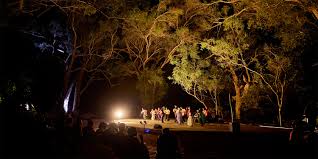
The natural environment amplifies the experience. Surrounded by towering trees beneath a canopy of stars, the audience sits informally on picnic blankets, hay bales, and low chairs, choosing their own vantage point. As night deepens, voices echo across the hills, dissolving the distance between stage and spectator.

In the closing moments, the invitation to join becomes literal. Guided by Daniel Wilfred, the audience joins in First Nations dance steps, transforming observation into embodied experience. The final communal rhythm encapsulates the project’s ethos: this is not spectacle, but shared ceremony.

Behind the seamless integration of ritual, music, and movement is Creative Producer Kamal Thurairajah, whose vision ensures that the evening unfolds as a cohesive and deeply felt journey.

What distinguishes The BhuMeJha Project is its commitment to long-term collaboration and genuine cultural exchange. This is not fusion for novelty’s sake, but a work shaped by years of trust-building and dialogue across communities. The evening moves through stages of arrival, immersion, performance, and celebration, culminating in shared food, music, and reflection under the night sky.

At its heart, The BhuMeJha Project is an invitation: to breathe more deeply, to listen more carefully, to feel the land beneath your feet, and to recognise the connections that emerge between different lineages bound by shared stories of river, earth, and belonging.

It is not merely watched… it is lived.

Perth Festival Review: Odedra’s Songs of the Bulbul

Through Kathak, Sufi music, and exquisite staging, Songs of the Bulbul channels grief, devotion, and ecstasy. This performance lingers long after the final note. The nightingale’s cry becomes both myth and meditation on the artist’s life.

In Sufi literature, the bulbul, the nightingale, is never just a bird. In the words of Rumi, Hafiz, and Attar, it becomes the human soul, restless and incandescent with longing. Opposite it blooms the rose, radiant, unattainable, a symbol of the Divine.

The bulbul sings, in ache and ecstasy, devotion fierce enough to pierce and consume. Its song trembles between rapture and grief. It yearns to transcend the self and return to what was never truly separate.

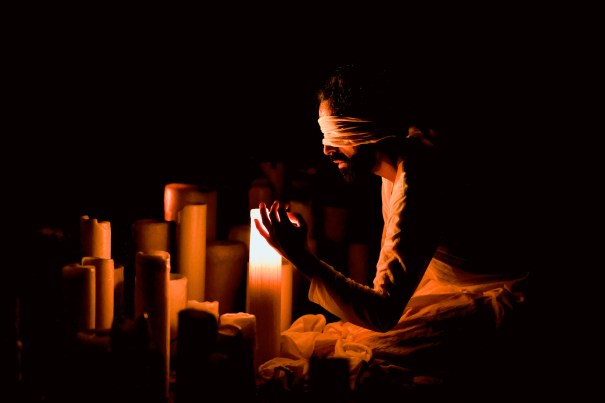
In Odedra’s performance, the nightingale’s eyes are gouged out, it cries, a sound suspended between grief and devotion. The myth transforms into a meditation on the artist’s life: giving everything in each act of creation, leaving pieces behind. Creation becomes both loss and offering, a language that carries beyond the body, the moment, and the eyes that no longer see.

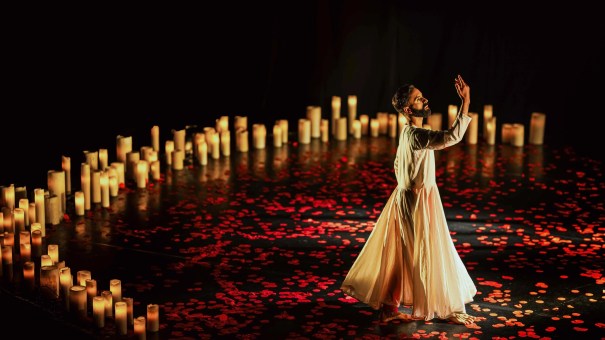
The dance begins at the edge of becoming. Odedra’s body curls, searching, holding itself in quiet tension. Slowly, he unfurls, tasting the vastness of the sky. Freedom emerges in subtle gestures, shifts of weight, turns, leaps, and precise Kathak footwork. Flight gives way to constraint as space tightens, echoing the passage of time and the narrowing of life. His spiraling body evokes the whirling dervishes, filling the expansive stage.

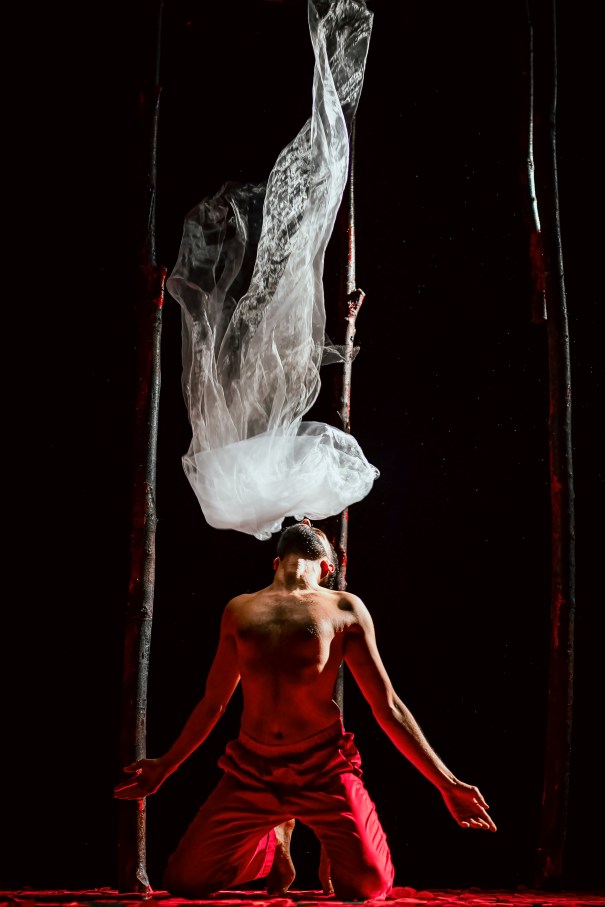
Rose petals drift and swirl as he glides, leaps, and spins, tracing the bulbul’s longing. In the final moments, candles flicker and gauze drifts onto the stage. Odedra lifts and sweeps the fabric, flowing with the light. Through the interplay of gauze, glow, and petals, the soul seems to rise; weightless, luminous, meeting the Divine.

Odedra is a striking dancer, his movements imbued with rare fluidity. His dance seamlessly blends the precision of Kathak with contemporary expression, creating a language of motion that is both technically breathtaking and profoundly emotive. The choreography, crafted by the acclaimed Rani Khanam, a master of the Lucknow gharana style of Kathak, draws deeply from Islamic and Sufi texts. She weaves tradition and imagination into every gesture, layering each movement with devotion, philosophy, and subtle beauty.

Music by Rushil Ranjan lifts the performance to another level. Sound and silence exist in equal measure, reverberating in the body long after notes fade. The qawwali Allahu Allahu Allahu pulses like a heartbeat, a call to presence beyond fear and noise. In a tense, fractured world, its repetition offers solace, insistence, and devotion.

Lighting designer Fabiana Piccioli bathes the stage in shifting shadows and gentle glows, sculpting space and mood so that every movement, rose petal, and flicker of gauze feels suspended in a luminous, almost otherworldly atmosphere.

Catch Songs of the Bulbul at the Perth Festival from February 13–15, 2026, and let yourself be carried into another world.

Songs of The Bulbul

Perth Festival Review: Odedra’s Songs of the Bulbul

Passionate about Indian Cinema and Dance

Have you been following Minai’s www.cinemanrityagharana.blogspot.com? Oh! What a treasure trove it is for us cinema enthusiasts, dancers, or anyone who appreciates Cinema and dance! The blog focuses on Indian dance forms in Indian cinema. I myself have looked up to that blog to find how our dance sequences in Indian movies have changed over the years. I have always wanted to know more about the writer behind this blog because trust me, that is a lot of research going into spotting the dancer on-screen, identifying the dance form and who the choreographer is. Minai’s blog makes all this easy for you.  Finally, I tracked down Cassidy Minai, the author of the blog and we spoke about her life, interests and her favourite Indian dancers on-screen. Continue reading “Passionate about Indian Cinema and Dance”

Tracing her Kalāvantulu Dancing Roots

Yashoda Thakore has fought against all odds to uphold the tradition of the Kalāvantulu community* and their dance repertoire. And what drove her with passion all these years? It is the realisation that she belongs to this artistic community. She is one among them. Let me take you through her journey of self-realisation and her commendable work that she has been doing so far and plan to do more in the future.

Continue reading “Tracing her Kalāvantulu Dancing Roots”