
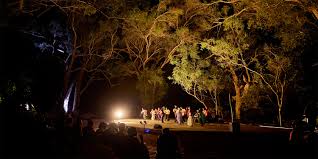
As part of Perth Festival, the BhuMeJha project is not simply a performance, it is an immersive ceremonial experience. Set against the fading light of the Perth Hills, the work invites audiences into a shared space of ritual, storytelling, movement, and cultural exchange. It moves beyond the conventions of traditional theatre, dissolving the boundary between performer and participant and guiding audiences through a multi-sensory journey grounded in land, lineage, and living tradition.
Presented at The Art Sanctuary in Kelmscott by Saraswathi Mahavidyalaya and Chitambara, the evening begins with a smoking ceremony – a gentle yet powerful invitation to pause, breathe, and arrive fully. The scent of sacred herbs drifts through the air. Guests wander the tranquil grounds. They explore spaces like Saraswati Ghat, Shiva Ghat, and the goshaala. Their experience is enriched by live music and homemade refreshments. The atmosphere encourages unhurried presence and quiet connection.
As dusk settles, the ceremonial performance unfolds. Artists bridging Noongar, Indian, Malaysian, and Yolŋu heritage weave chant, rhythm, and storytelling into an evocative expression of shared land and ancestry. At the heart of the soundscape is Wagilak Yolŋu Songman Daniel Wilfred, whose powerful vocals resonate through the amphitheatre. Music designer and performer Hariraam Tingyuan Lam works with Malaysian artist Mohammad Hisharudy. Together, they layer Indian and Malaysian musical traditions into a sonic landscape. This landscape feels both expansive and intimate.
Under the mentorship of Sukhi Shetty Krishnan, Creative Director at Saraswati Mahavidyalaya, dancers move in a fluid, boundary-crossing vocabulary drawing from contemporary practice, Garba, Bharatanatyam, folk, Kathak, Odissi, Kandyan, and contact improvisation. A First Nations dancer (I wish I knew her name and couldn’t find her name in the credits as well.) mirrors and responds to these forms, exploring the profound and unifying theme of Mother, Ma Ganga, creating a compelling cross-cultural dialogue through gesture and breath. The choreography resists categorisation; instead, it unfolds deliberately, allowing each movement and note space to resonate.
The natural environment amplifies the experience. Surrounded by towering trees beneath a canopy of stars, the audience sits informally on picnic blankets, hay bales, and low chairs, choosing their own vantage point. As night deepens, voices echo across the hills, dissolving the distance between stage and spectator.
In the closing moments, the invitation to join becomes literal. Guided by Daniel Wilfred, the audience joins in First Nations dance steps, transforming observation into embodied experience. The final communal rhythm encapsulates the project’s ethos: this is not spectacle, but shared ceremony.
Behind the seamless integration of ritual, music, and movement is Creative Producer Kamal Thurairajah, whose vision ensures that the evening unfolds as a cohesive and deeply felt journey.
What distinguishes The BhuMeJha Project is its commitment to long-term collaboration and genuine cultural exchange. This is not fusion for novelty’s sake, but a work shaped by years of trust-building and dialogue across communities. The evening moves through stages of arrival, immersion, performance, and celebration, culminating in shared food, music, and reflection under the night sky.
At its heart, The BhuMeJha Project is an invitation: to breathe more deeply, to listen more carefully, to feel the land beneath your feet, and to recognise the connections that emerge between different lineages bound by shared stories of river, earth, and belonging.
It is not merely watched… it is lived.
 NatyaLoka